Archive for February, 2008
Is a 2x Extender worth using?
Do a web search for “Canon 2x extender” and you will find quite an assortment of articles, tests and discussions on whether it is worth using. The problem is that adding an extender means adding more glass which means more image degradation. Actually, it stands to reason that the more glass you put in front of the sensor the more the image will degrade. The question I had is whether the amount of degradation was still better than shooting with 1/2 the focal length (without an extender) and cropping to get the same sized image as with the extender. By the way, the tests done here were using the revised Canon 2x II extender.
So the real question here is whether an image shot with the extender can equal the cropped image shot without it. The problem will lie in the number of pixels we need for the resulting final output. If we are going to create a print then we need to think about what size will be required. I’m using and 8.2 MP camera which is probably the lower limit you want to use and perform any cropping. Image size measures 3405 x 2332 pixels. If I shoot an image with a 400mm equivalent focal length using a 2x extender (in this case I am using a 200mm lens) and then shoot the same subject using a 200mm focal length (no extender) how much cropping will be required to achieve an equal size subject on print.
Actually, it’s simple math. I need to increase the size of the image shot at 200mm by 2 times. That doesn’t sounds so bad until you actually crop the image and realize how many pixels you have to throw away!
This screenshot shows the full size 200mm image with a crop rectangle over it. 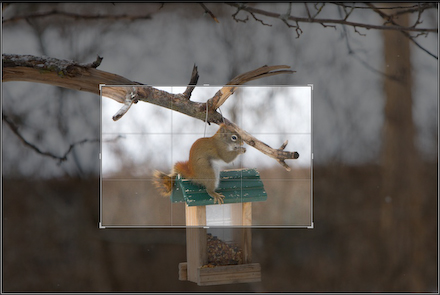 That is quite a bit of cropping on an 8 megapixel image. Would there be enough left to create a decent sized print? Would the image quality still be good?
And here is the 200mm image after it was cropped. 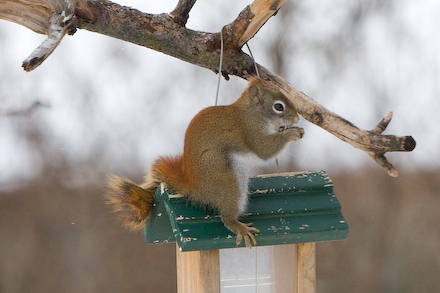 Of course it is quite reduced for this blog page, but I can say that at full size its looks very good on my monitor. I was actually quite surprised. The only problem is that if I were to print this image at 240 dpi it would be limited to a 5 x 7.
Here is 400mm image (taken with the 2x extender). 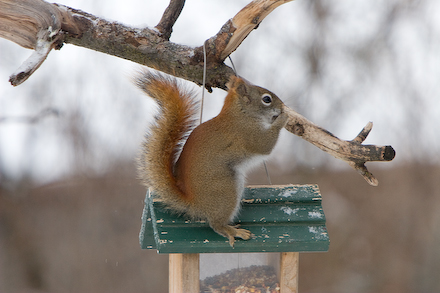 It looks surprising comparable to the 200mm image after it was cropped. I do notice some very minor loss of detail, mostly off center (evident on the branch), but after I did this test and started looking at the 2 images I had to keep looking at the original files to remember which was which. But the big advantage with the extender is that I have the full pixel count to print with. So instead of being limited to a 5 x 7 I can now print a much larger 15 x 10. That’s a huge difference.
Now keep in mind that in this test I did some level and sharpening adjustments to get the best possible image just like I would normally if I was to print these. It is interesting to note that although the level adjustments for both images were similar, the sharpening was not. Of course that makes sense when you consider the fact that sharpening works on the analysis of pixels and there are twice as many in one image versus the other. It is interesting to note, however, that once I tweaked them individually for the best possible quality they were almost identical when completed.
Now before I trumpet the use of a 2x extender I must also bring to light… the light it needs. With the 2x extender you lose 2 stops of light. And to improve image quality using the 2x extender I stop it down one more stop. The 200mm image was shot using an F-stop of 4 (on a 2.8 lens) and the 400mm image was taken with an F-stop of 8. That makes a significant difference in shutter speed. The lighting was similar when both images were shot although probably not identical. The 200mm image had 1250 msec while the 400mm image had only 125 msec. That’s a huge difference! In reality there should only be 2 stops of difference due to the 2 stop difference in aperture, but in reality that is what it came out to. If you are shooting relatively stationary subjects with a tripod or good image stabilized lens then it’s not a problem. I guess I was lucky in that there are not many squirrels that are going to be still enough to capture with a 125msec shutter speed.
Bottom line is that the 2x extender does have a usefulness. It does give 2 times the reach when you have lots of light and don’t need a really fast shutter speed. And if you need the reach on a bright sunlite day you will get some beautiful large images. But when the light is not good or you need a fast shutter speed then leave it off and try to get closer.
What it takes to catch a bird
If you have never tried then you probably don’t know what I’m talking about. It seems relatively easy. You see a bird in a feeder and so you point the camera at it and snap off a picture. Darn! He moved just as I pressed the shutter release. So you try again. And again. And again! You know what? They never really stay still! And when you do finally get a picture the first thing you notice when you bring it up on your computer screen is how small the bird is in the photo!
The fact is that birds, even the ones outside the window in the bird feeder, are hard to photograph. I should know. I have been taking pictures of birds and chipmunks and squirrels and even deer in my backyard for quite some time. When it comes to birds it is always a challenge. They are always moving and their movements are quick so you either time it just right and get them between movements or you use a very fast shutter speed. And then there is the fact that birds are most active just around sunrise and sunset. At those times the light is at a premium… definitely not enough to get fast shutter speeds. There is nothing worse than seeing a cardinal in the feeder, but it’s too dark to get a pic!
It’s also interesting that the same problems I have experienced in getting bird photos I have also found to be a problem with sports photos. As you would expect for sports you need a fast shutter speed to stop the action. But you also need a fast focus because you are always trying to catch a moving target. For as many good sports photos as I have captured there were a lot more I missed because it wasn’t in focus or the light was insufficient to use a fast enough shutter speed to stop the action.
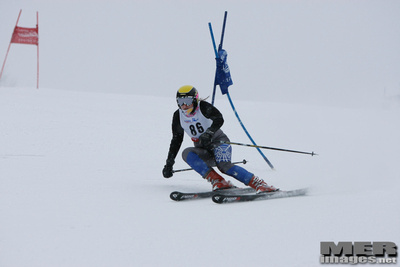
Ski racing is a challenge because you get maybe 2 seconds each run to snap off a series of photos. And if the autofocus gets confused… then you get nothing. Unfortunately, that has happened way too many times when trying to photograph my daughter this season. At least in basketball I have an entire game to get some decent shots, but even that has been a challenge for me. The gyms are poorly lit which means I need to push up the ISO sensitivity. That adds grain in the photos which makes them not as clear. And in order to get a reasonable shutter speed I purposely underexpose which means they will require some post processing adjustment before publishing them. And you thought all I did was just snap pictures and they magically appeared on my website. That process might have to be the subject of a future blog entry… what I do with the rest of my evening after a shooting a game!?!
Fortunately, there seems to be a solution to these issues. Use the right lens for the job. There are lenses that have larger openings to let more light in. That allows for a faster shutter speed while retaining proper exposure. It also improve focus speed and accuracy. The only problem with these lenses is that they are big and heavy!
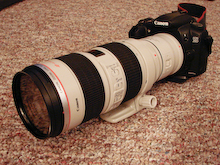
With faster shutter speeds and instantaneous autofocus a larger lens takes care of the capture of sports action. But what about those small birds? You can finally get photos of them, but they are still so small! The solution to that is a long lens. The problem with a long lens with a large aperture is that is really, really heavy! There are some lenses that weigh over 10 pounds! The are designed for tripod only use and definitely not something you walk around with. Another solution is to use a shorter lens and add an extender. The extender is an attachment that multiplies the focal length (reach) by some value, usually 1.4 or 2. That means that a lens with a max focal length of 200mm will become a 400mm lens with a 2x extender.
The disadvantage of an extender is that there is some degradation in quality of the image and there is also some loss of light so you will not be able to attain as fast a shutter speed as you could without the extender. But it is a less expensive and more versatile option than a single long lens because you can always remove the extender when working in low light conditions or indoors. In my case a 70-200mm focal length will work well for basketball and ski racing. And when I want to shoot those tiny birds or distant wildlife I can add the extender and get the extra reach.
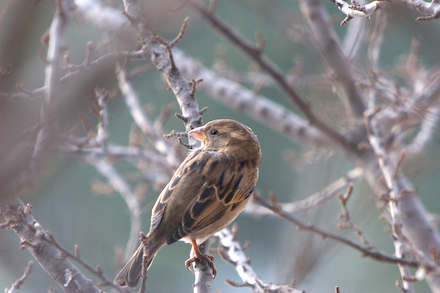
So far the bird photos have proved very promising. The photo of the tree sparrow was shot using the 2x extender. Obviously the quality is still good enough to get very decent pics. By the way that is an upcropped photo. Usually I would have to crop my photos quite a bit to get a bird that large in the photo. As for indoor basketball… we will see Friday night which is Neal’s next home game. I’ll keep my fingers crossed!
-
You are currently browsing the archives for February, 2008
 Subscribe via RSS
- A Year of Making Movies August 12, 2011
- Why I Hate to Love Apple July 28, 2011
- A Look Back At My 2010 December 30, 2010
Featured Images